Why It Takes Three Tugs to Dock a 366-Meter Container Ship
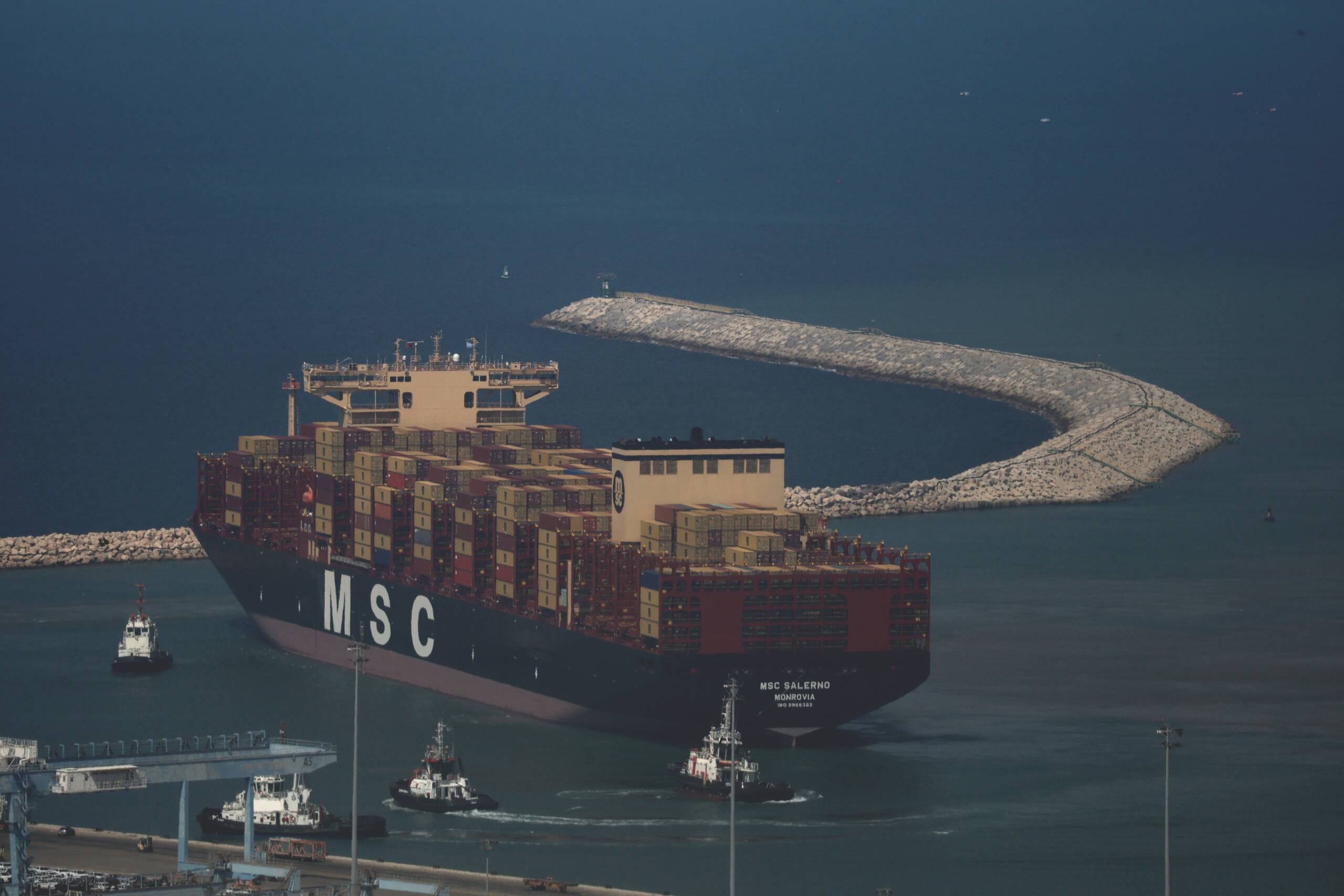
A modern container ship arrives at the breakwater doing four or five knots and immediately becomes the least maneuverable object in the harbour. That’s the part people miss when they watch the process. The ship isn’t being helped along. It has effectively stopped being able to steer itself, and three small boats are now doing the job its 60,000-kilowatt main engine can’t.
The reason is that a rudder is a wing. It only produces side force when water is flowing past it, and the flow comes from the propeller and from the ship’s own speed. Slow down and the rudder goes quiet. Somewhere around three or four knots a large box ship loses useful steerage, which is exactly the speed range where you need precision the most. Bow thrusters fill part of the gap, but only part. They lose grip once the vessel has any headway at all, and they push at the bow only, which means they can turn a ship without being able to hold it anywhere in particular.
Then there’s the wind. A ship like this one is 366 meters long and 51 wide, and the container stacks sit eight or nine high above the deck. From the side it presents a wall of steel a couple of thousand square meters in area, more when the deck load is tall and light. A moderate beam breeze against that wall produces lateral force in the tens of tonnes. A strong one produces several times that. A tug is rated by bollard pull, the straight-line force it can exert at zero speed, and a decent modern harbour tug does somewhere between 60 and 90 tonnes of it. Do that arithmetic and the tug count stops looking generous.
Numbers aren’t the whole story either. Force has to be applied in the right place. One tug can push. Two can push and rotate, which is what you need to bring a hull parallel to a quay it approached at an angle. A third, usually made fast aft or working as an escort, gives the pilot a brake and a way to check the swing before it develops. Ships this size don’t have a reverse gear in any meaningful sense. Stopping means either running the engine astern, which is slow and takes the rudder out of the equation entirely, or letting the tugs absorb the momentum. Most port authorities publish a schedule that sets minimum tug numbers and combined bollard pull by vessel length, draft and beam, so the pilot isn’t inventing the answer on the day.
Towage is a concession business, not a shipping business
Here’s what makes towage interesting commercially rather than just technically. In most ports it isn’t a competitive market. The port authority grants a concession to one operator, sometimes two, and the service is compulsory by regulation for vessels above a size threshold. The buyer has no realistic ability to walk away, shop around mid-approach, or decide the wind looks fine today. Demand is set by the port’s own rulebook.
That produces a business with characteristics closer to regulated infrastructure than to shipping. Revenue tracks port calls and vessel size rather than freight rates, which means towage keeps earning through the parts of the cycle when carriers are losing money. The trade-off is that pricing usually sits under a published tariff, concessions come up for tender, and the operator carries the whole cost of being ready.
Being ready is expensive. A modern ASD tug costs on the order of a small office building and does nothing productive for most of its life. It has to be crewed around the clock because ships arrive around the clock. Fuel, class surveys, drydocking and a crew of three or four run whether or not anyone calls. When an hour of tug time looks costly relative to the twenty minutes of actual pushing, that’s why. You’re renting standby capacity, not labour.
The sector consolidated accordingly. Svitzer has been a standalone listed company since Maersk spun it out in 2024, Boluda absorbed Kotug Smit and built a European network, and SAAM has been buying up Latin American operators. Scale matters here because a group that holds thirty concessions can move hulls between them, share crews and finance newbuilds against a diversified book. A single-port operator can’t.
The constraint nobody budgets for
Terminal investment goes into cranes, yard automation and gate systems, because that’s where the visible throughput numbers come from. The tug fleet tends to be somebody else’s balance sheet. But the berthing window is what actually sets how many ships a terminal can turn, and the berthing window depends on having enough bollard pull available at the moment the ship shows up.
Ships got bigger faster than tug fleets got stronger. A port that upgraded its quay wall and dredged its channel for neo-Panamax and larger tonnage sometimes finds it now needs four tugs where it used to send two, drawn from a fleet sized for the old traffic. That shows up as waiting time, which shows up as schedule reliability, which is the metric shippers actually complain about.
New tonnage is coming, and it’s changing shape. Hybrid and fully electric harbour tugs are in service in several European ports, which suits a duty cycle that’s mostly idle with short bursts of full power. Remote-operated trials have run in Asia and Scandinavia. Neither changes the underlying physics.
The ship in the photo cost something north of a hundred million dollars and carries cargo worth many times that. For the last mile it is entirely dependent on three boats that cost a fraction of one percent of the cargo value. That asymmetry is the whole business.