Is Hormuz Lost for Container Traffic? Jebel Ali's Collapse and the Gulf of Oman Rebuild
The honest answer is that container traffic is further gone than tanker traffic, and for reasons that have almost nothing to do with how the war ends. Crude can move on a shadow fleet with the transponders off. A 19,000 TEU boxship on a fixed weekly rotation cannot. What is being lost is not the waterway. It is Jebel Ali’s position as the default first port of call for the Middle East.
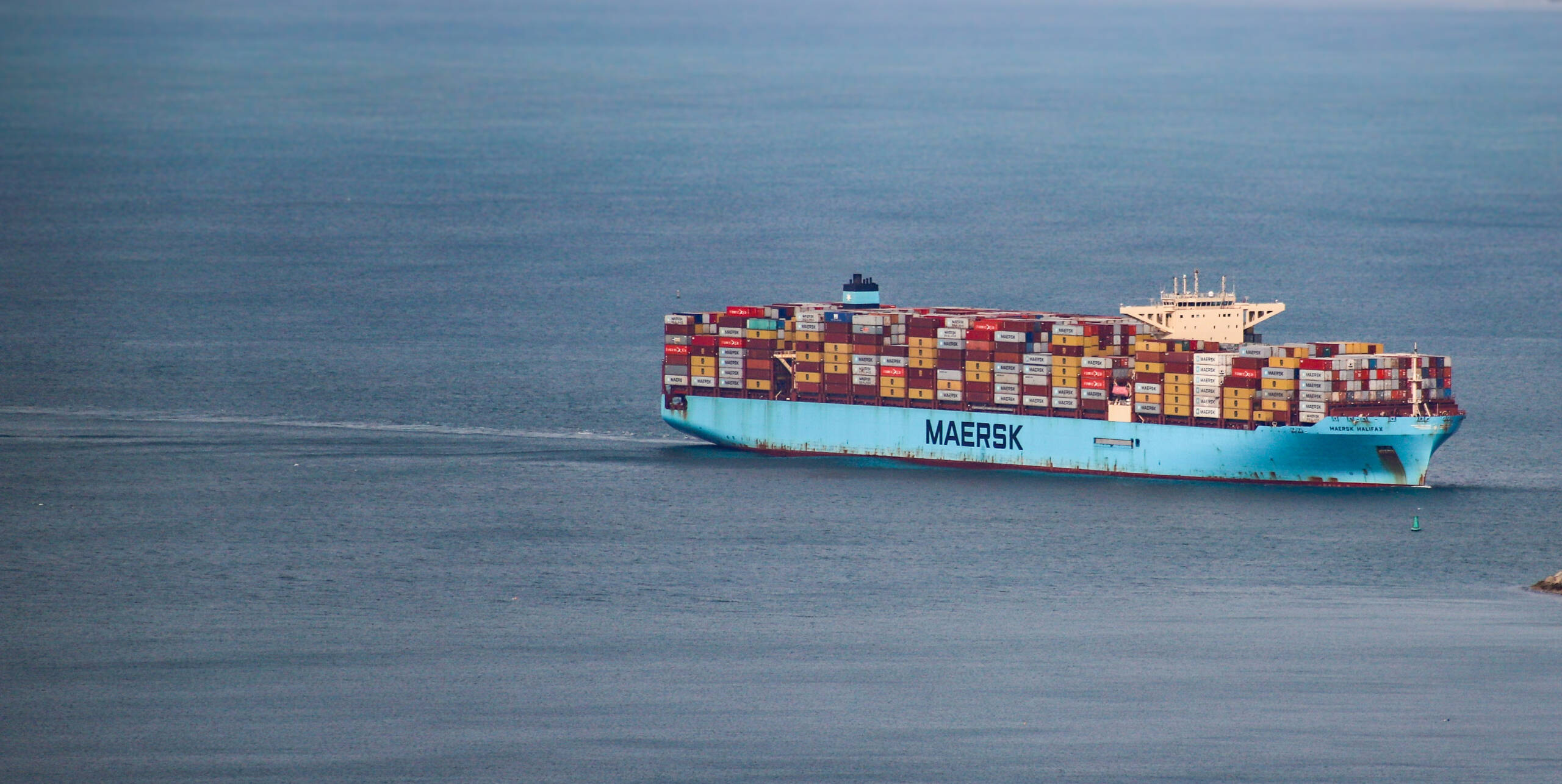
Start with the numbers, because they have been moving. Preliminary tracking for the week of 27 July to 2 August showed 84 transits through the strait, up from 45 the week before, with containerships and gas carriers resuming trackable movement after a short pause. That sounds like recovery until you set it against a pre-crisis baseline somewhere between 88 and 130 vessels a day. On 2 August, two ships went through. The strait is not closed in a legal sense. It is closed in the only sense that matters to a liner scheduler, which is that you cannot promise a customer a sailing date.
Why the box trade broke differently
When the shooting started at the end of February, Alphaliner counted 138 containerships confined inside the Gulf, roughly 470,000 TEU of capacity, with MSC and CMA CGM carrying the heaviest exposure. War risk cover for the strait was pulled in early March. MSC terminated Arabian Gulf shipments outright. Within days the major lines had stopped transiting, suspended direct mainline calls at Jebel Ali and the other upper Gulf ports, and turned their attention to extracting ships and crews that were already inside.
That sequence matters. A tanker owner facing this situation weighs a single voyage against a freight rate that has tripled. A liner operator is weighing a whole network. One ship stuck at Jebel Ali for three weeks does not just lose that ship, it blows a hole in a string that touches Asia, the Mediterranean and East Africa. The rational response is to cut the Gulf out of the rotation and serve it from outside, which is exactly what happened.
Then there is the sanctions problem, which the tanker trade has largely solved through opacity and the container trade cannot. Iran’s draft transit legislation targets vessels with US and Israeli links and threatens fines pegged to cargo value. Every one of the top carriers has US customers, US port calls and US-linked charter and insurance relationships. There is no version of Maersk or Hapag-Lloyd running a Hormuz service with the AIS off. The dark fleet workaround is structurally unavailable to them.
The capital has already moved
This is the part that makes “lost” a reasonable word rather than an alarmist one. DP World signed a 50-year concession on 22 July with the Fujairah Ports Authority for two deepwater terminals on the Gulf of Oman coast, outside the strait entirely. Al Rugaylat takes containers, vehicles and general cargo, Dibba takes general cargo. Together they lift DP World’s UAE container capacity from about 19.4 million TEU to close to 22 million, and they connect inland to Jebel Ali and the Jafza free zone by road rather than sitting as a stranded east coast outpost.
Around that, a full alternative architecture has assembled itself. Khor Fakkan and Fujairah took the ad hoc mainline calls in March. Sohar, Salalah and Duqm absorbed relay volume. The Saudi Red Sea gateways at Jeddah and King Abdullah Port anchor a landbridge across the peninsula, although that corridor has been throttled by in-transit customs processing rather than by any shortage of trucks, and several lines simply stopped accepting in-transit bookings through Jeddah. Roughly 200,000 TEU has reached Jebel Ali overland. DP World’s first-half profit rose 52 percent, driven substantially by storage demand, which is what a P&L looks like when cargo arrives and then sits.
None of that is a hedge any more. Concessions get signed, terminals get built, feeder strings get published, and shippers rewrite routing guides. Those decisions have multi-year payback periods and they do not reverse because a communiqué gets signed in Muscat.
What could still come back
The distinction that decides this is between relay cargo and gateway cargo. Jebel Ali built its position on transshipment, boxes that touch Dubai only because Dubai was the cheapest place to change ships between Asia, the upper Gulf, East Africa and the subcontinent. That volume is footloose by definition. Once Salalah and Fujairah prove they can hold the connection, there is no commercial reason to route it back through a chokepoint that carries a war risk premium and a headline risk.
Gateway cargo is different. Containers genuinely destined for the UAE, Iraq, Kuwait, Qatar and Bahrain have to be delivered, and the upper Gulf economies are not going to shrink to fit the new port map. That demand comes back the moment transit is insurable. The open question is whether it comes back by ship through Hormuz or by truck from the Gulf of Oman, and the UAE has spent the last five months making sure the truck answer works.
Both Washington and Tehran signalled on 5 August that an arrangement is close, and Qatari mediators are pushing a short-term framework. Assume it holds. Transits recover, the stranded ships and the seafarers on them get out, and rates fall back. What does not recover on the same timetable is the service pattern. Insurers move slower than diplomats, charterers have committed tonnage elsewhere, and the terminals now being built in Fujairah will open whether or not the strait is quiet.
So: not lost, if the question is whether containerships will ever transit Hormuz again in volume. Lost, if the question is whether the pre-2026 map comes back. The region has spent this year buying itself the option not to need the strait, and options that expensive tend to get exercised.