Cruise Turnarounds and Container Terminals in One Basin: The Costs Ports Absorb Quietly
A cruise ship at a commercial berth looks like a nice piece of civic branding. Passengers on deck, cranes in the background, the whole port working at once. What the picture does not show is that for the length of that call, a container terminal has been operating with one hand tied behind its back.
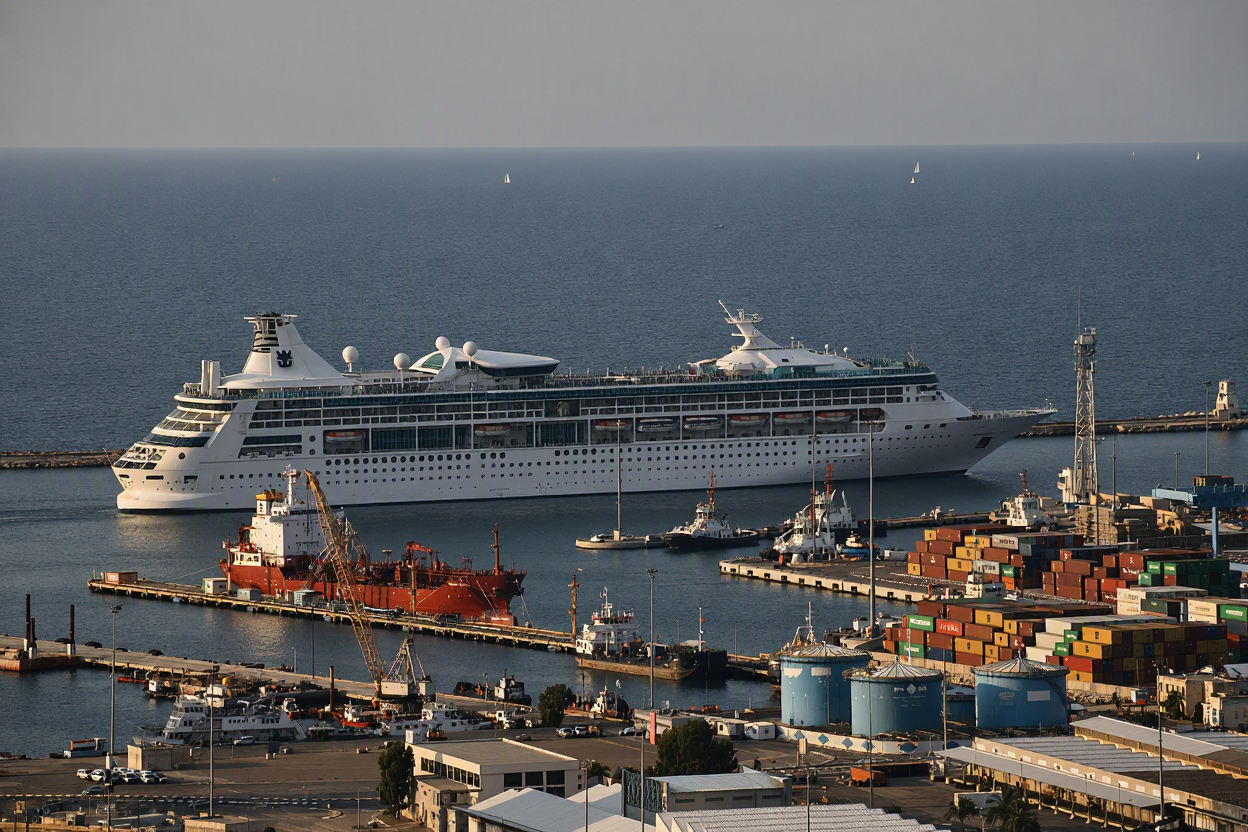
Most mid-size ports that handle both passengers and boxes never built a separate cruise facility. The cruise business arrived later, or seasonally, or as a political initiative, and it got slotted into whatever quay had the depth and the road frontage. That quay is almost always the good one. Deep, long, close to the gate, with the cleanest apron. It is also the quay the container operator would otherwise be using for its highest-productivity work.
Berth Scheduling Is Not a Negotiation Between Equals
Container berthing is elastic in a way cruise berthing is not. A box ship that arrives four hours late gets worked four hours late, and the terminal absorbs it with overtime and gang reshuffling. Productivity is measured in moves per hour, and the operator has levers to claw back a slipped window.
A cruise turnaround has no such give. Passengers are booked on flights. Provisioning trucks are scheduled to the half hour. Immigration staff are rostered for a specific arrival. The ship is berthing at 07:00 and sailing at 18:00, and everything else in the basin arranges itself around that fact.
So the terminal plans defensively. It blocks the shoulder hours on either side, because it cannot risk a box ship still being worked when the cruise ship needs the approach clear. A ten-hour call becomes a thirteen or fourteen hour hole in the berth plan. Over a summer season with two or three calls a week, that is real capacity, and it does not appear in any cost line. It shows up later as vessel waiting time and as customers quietly shifting volume to a port that does not have this problem.
The Security Envelope Sterilises Ground
The bigger operational bite is the ISPS perimeter. Embarkation requires a sterile area: screened passengers, screened baggage, controlled access, no unvetted vehicle movement through the zone. For the duration of the call, a chunk of working yard becomes a restricted passenger facility.
That means yard equipment cannot cross it. Internal transfer routes get rerouted around the perimeter, which lengthens every straddle carrier or terminal tractor cycle in that part of the yard. Stack positions inside or adjacent to the zone become unusable for the day, so the planner has to pre-position those boxes elsewhere, which is extra handling nobody bills for.
Then there is hazardous cargo. IMDG segregation rules already dictate where classified stacks can sit. Add a temporary passenger concentration a few hundred metres away and the permissible slots shrink further. Ports running mixed basins routinely find their dangerous goods capacity constrained not by the regulation itself but by the cruise schedule interacting with it. The workaround is to keep DG stacks permanently at the far end of the yard, which means permanently longer transfer distances, on every day of the year, for the sake of two calls a week.
Everyone Uses the Same Gate and the Same Road
Container trucking peaks at gate opening. Drivers queue before dawn to get a first-round slot. A cruise turnaround peaks between roughly 09:00 and 13:00, when disembarking passengers leave by coach and taxi while embarking passengers arrive, and it overlaps with provisioning deliveries, bunker trucks, waste and sludge collection, and crew transport.
In a purpose-built cruise terminal these flows never meet freight. In a shared basin they run through the same gate complex and the same access road, which in older ports is frequently a single arterial connection to the highway network. Two thousand passengers moving in four hours is a few hundred vehicle movements. Dropped into a truck queue that was already the constraint on gate throughput, it produces exactly what you would expect.
The port usually responds by capping truck appointments on cruise days or shifting them to evening slots. That works, in the sense that the queue clears. It also pushes cost onto hauliers and shippers, who now have a port that is unpredictable two days a week in summer. Predictability is what freight customers actually buy.
Why Ports Keep Doing It Anyway
Because the revenue looks good on the page. Dockage plus passenger head tax on a mid-size ship is a decent day’s income for a quay, and the political value is much larger than the money. Passenger numbers are countable, photogenic, and easy to put in an annual report. Container throughput growth of a few percent is not.
The cost sits somewhere else. It sits in the terminal operator’s yard productivity, in a haulier’s waiting time, in a shipping line’s schedule reliability statistics. None of those parties writes the cruise contract, and none of them gets consulted when the season is extended by six weeks.
The ports that resolve this properly do one of three things. They build a separate passenger quay with its own gate and its own road connection, which is expensive and slow but ends the problem permanently. They schedule cruise calls into structurally quiet container windows, typically Sunday and mid-week nights, and accept fewer calls in exchange for clean separation. Or they run a truck appointment system good enough that the gate can genuinely absorb a passenger peak without the queue collapsing.
What does not work is the default. Put the cruise ship on the best berth, hope the yard planner sorts it out, and count the passengers.