Hormuz and Taiwan Strait Risks Reach Supply Chains Through Different Costs
A freight booking can survive a crisis on paper while the delivery plan falls apart. The vessel still exists, the purchase order remains open and the warehouse has a receiving slot. What disappears is confidence in when the cargo can move. That is the transport problem connecting two reports published on November 1, 2026: a severe interruption around Hormuz and a more contained, unsettled situation around Taiwan. For a manufacturer or distributor exposed to both regions, they belong in the same supply-chain review, with different responses attached.
The starting evidence comes from Hormuz.net’s first Hormuz Risk Gauge report, which assigns the Gulf chokepoint a score of 75 in its High band, and TaiwanStrait.com’s first Taiwan Strait Tension Index report, which puts the Taiwan reading at 33.4, or Watchful. These are each publisher’s composite indicators. They use different inputs, so the scores do not give a common probability of delay, closure or conflict. Their value for transport planning lies in the evidence underneath them.
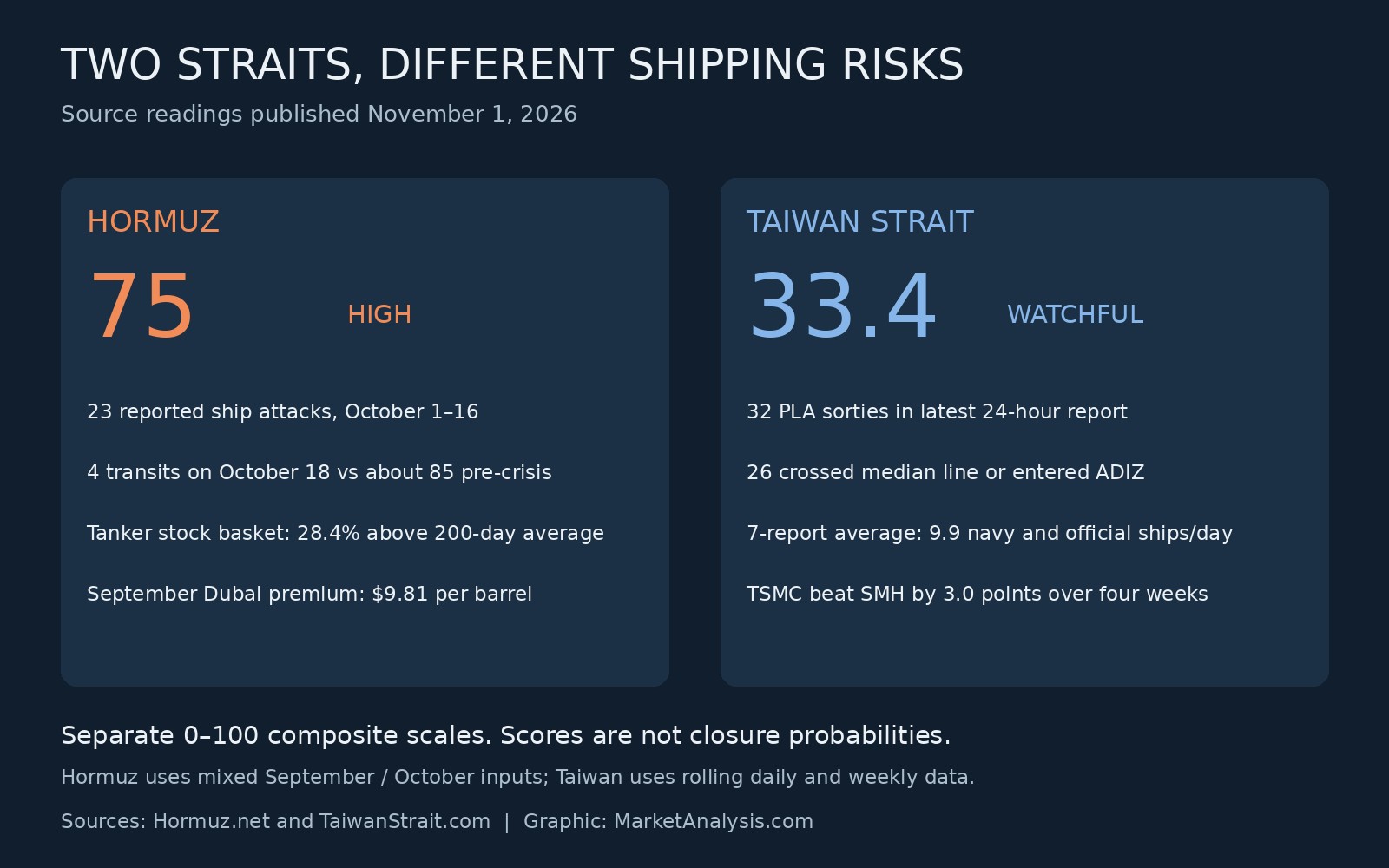
Infographic hosted by MarketAnalysis.com, using findings credited to Hormuz.net and TaiwanStrait.com.
The image makes the split visible. Against a dark navy background, two broad panels put Hormuz’s orange 75 beside Taiwan’s pale blue 33.4. The Gulf side groups reported attacks, a thin transit count, tanker equity strength and the Dubai crude premium. The Taiwan side groups aircraft sorties, median-line or ADIZ activity, sustained vessel presence and TSMC’s relative stock performance. A note beneath the panels explains the different observation periods. That detail is easy to overlook, and consequential: the graphic is a summary of the reports, rather than a live dispatch board.
Start with the cargo’s point of origin. Hormuz.net cites four PortWatch transits on October 18 against roughly 85 a day before the crisis, alongside 23 reported attacks in the first sixteen days of October. Those are dated observations reported by the source, not a fresh count for every November sailing. For a buyer awaiting Gulf cargo, they raise a practical question before any rate negotiation: can the supplier deliver to an export point that the contracted vessel can actually serve? A longer sea route only helps after cargo reaches navigable water. Substituting an origin, arranging an inland leg and rerouting a ship are different projects, with different contracts and lead times.
Next comes the cost of uncertainty. A delayed replenishment can leave a warehouse short, then produce a compressed arrival window when several postponed consignments move together. That is a planning scenario rather than a flow measured by either index. Its consequences reach trucking appointments, storage capacity and production schedules. A procurement team comparing transport offers should therefore record which departure is supported by a real booking, what happens if loading slips and which additional charges remain outside the quoted price. The cheapest displayed freight rate settles very little if the delivery date is unusable.
Hormuz.net’s market data helps explain the commercial tension. Its basket of five tanker owners traded an average 28.4% above the 200-day moving average as of October 23; Dubai crude averaged $9.81 a barrel above Brent in September. The source interprets those readings as evidence that disruption is being priced into ships and deliverable Gulf oil. Neither number is a freight surcharge that can simply be added to a customer’s invoice. They are signals for testing suppliers’ assumptions. A carrier seeking a higher payment still needs to explain the service, cost exposure and contractual basis.
Taiwan presents a different purchasing decision. TaiwanStrait.com reports 32 PLA sorties in the 24 hours ending at 6 a.m. on November 1, with 26 crossing the median line or entering the air defense identification zone. Naval and official vessel presence averaged 9.9 ships a day across seven reports. Its account describes intermittent air surges over a steadier maritime presence. It does not establish that commercial port access has stopped. An importer should connect military developments to observable transport changes before cancelling a service or paying to shift cargo.
A useful contingency identifies the shipment that would stop production first. Some urgent, compact components might justify air freight if suitable capacity and operating airports remain available. Bulk commodities and large consignments face very different constraints. Alternative transport also cannot replace a component that has not been manufactured or released by its supplier. This is where a transport plan needs purchasing and production staff at the same table: a substitute route, a substitute part and a substitute supplier solve separate problems.
The Taiwan report also finds that TSMC outperformed the SMH semiconductor fund by 3.0 percentage points over four weeks to October 30, despite both falling. Its index therefore registers limited Taiwan-specific stress through that equity measure. Cargo managers should keep the inference narrow. Semiconductor share prices cannot confirm a container departure, insurance coverage or an airport’s operating status. Similarly, the Hormuz gauge includes September oil averages alongside October equity and incident inputs, which limits how quickly it can describe a changing voyage environment.
For transport buyers, the strongest response is to attach each contingency to a concrete trigger: a carrier withdrawal, a port restriction, unavailable insurance or a supplier’s missed release date. Keep the trigger, the responsible person and the replacement delivery plan together. Maritime Shipping’s companion analysis examines the ship and voyage exposure in more detail. The broader distribution problem is what happens after a disruption enters the order book: who carries the extra inventory, who pays for urgent capacity and which customer receives the remaining stock.