Machine Vision And AI Are Rebuilding Transportation From The Sensor Up
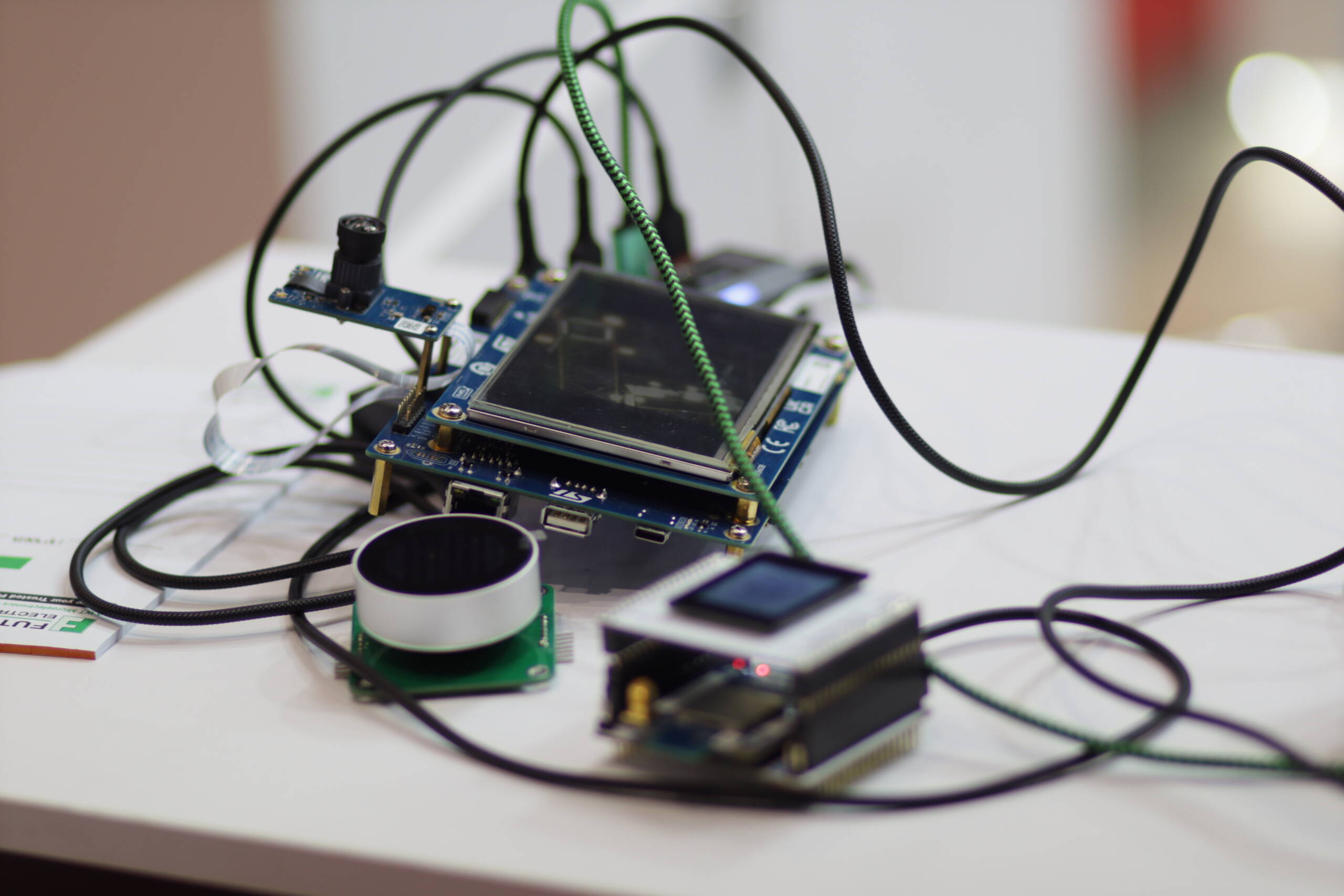
A development board bristling with cables tells the real story of autonomous transportation better than any glossy concept car. Strip away the marketing and what’s left is a stack of cameras, ultrasonic rangefinders, microcontrollers, and displays wired together to solve one narrow problem: understanding what’s happening around a moving object, fast enough to act on it.
Perception Is The Bottleneck, Not The Motor
Vehicles have been mechanically capable of autonomy for decades. What has changed is the ability to perceive. A small camera module like the one shown here can now run object detection models directly on embedded silicon, without round-tripping to the cloud. Combined with an ultrasonic sensor for close-range obstacle detection and a microcontroller board handling the fusion logic, this is effectively a miniature version of what sits inside a modern advanced driver assistance system. The difference between a demo kit on a lab bench and a production vehicle is scale and redundancy, not the underlying architecture.
Sensor Fusion Has Become Core Infrastructure
Through 2026, sensor fusion has moved from an experimental ADAS feature to standard infrastructure across advanced driver assistance and automated driving platforms. No single sensor modality holds up under every condition: cameras deliver rich semantic detail but degrade in poor lighting and weather, radar sees through fog and rain but lacks resolution, and lidar offers precise depth at a cost and power budget that still limits deployment. The practical answer has been to fuse all three, letting AI models reconcile heterogeneous inputs into a single environmental model that supports navigation and split-second decision-making.
Edge compute is what makes this tractable outside the lab. Running perception pipelines on-device rather than in a data center cuts latency to the point where a vehicle can react to a pedestrian stepping off a curb in the time it actually matters. That’s the same design principle visible in compact vision boards paired with dedicated microcontrollers: keep the inference loop physically close to the sensor.
Where The Economic Pressure Is Concentrated
Freight is absorbing this technology fastest. Autonomous trucking already accounts for the largest share of the commercial autonomous vehicle market, driven less by novelty than by a persistent driver shortage and the economics of highway-mile automation, which is a substantially easier perception problem than dense urban driving. Predictive maintenance is the quieter half of the story: AI-driven analysis of vehicle sensor data is measurably cutting fleet repair costs, turning machine vision from a driving function into a fleet management one.
Passenger-side, safety data from robotaxi operators now shows autonomous systems producing dramatically fewer serious-injury crashes than human-driven baselines, though public trust continues to lag the statistics. That gap between demonstrated safety performance and consumer confidence is arguably the larger obstacle to scaling autonomy in cities, more than any remaining sensor or compute limitation.
The Hardware Layer Is Where This Gets Decided
What a bench full of dev boards makes obvious is that the transportation AI story is fundamentally a hardware story: which camera modules, which microcontrollers, which sensor combinations get cheap enough and reliable enough to ship at automotive volumes. The algorithms are increasingly commoditized. The differentiation is shifting toward the physical layer — calibration accuracy between sensors, compute-per-watt at the edge, and the ability to validate a perception stack across weather, lighting, and traffic density that no lab bench can fully replicate.
That’s also why this generation of transportation AI looks less like a single breakthrough and more like the slow, unglamorous accumulation of engineering: better cameras, tighter fusion, faster edge inference, one wired-together prototype at a time.