Shipping Giant MSC Halts Gulf Exports as War Risk Freezes Trade Through the Strait of Hormuz
The moment a shipping line begins to treat a trade route as a war zone, the implications stretch far beyond a single voyage. Mediterranean Shipping Company, the world’s largest container carrier, has halted exports from Gulf ports as the security environment surrounding the Strait of Hormuz deteriorates. What might appear at first glance as a corporate logistics decision is in reality a signal that one of the most critical arteries of global trade has entered a period of extreme uncertainty.
The photograph captures a scene that normally represents the routine rhythm of global commerce. A massive container vessel bearing the unmistakable MSC lettering stretches across the frame like a floating industrial city. Stacks of containers rise in orderly blocks along the deck, painted in the familiar colors of global shipping alliances—muted reds, yellows, and browns, with logos from lines such as Yang Ming and ONE visible among them. Towering red gantry cranes loom above the ship, their long angled arms frozen in position like mechanical herons waiting for the next container lift. The sea behind the vessel is calm and pale blue, the kind of quiet harbor water that usually signals stability and predictable movement of cargo.
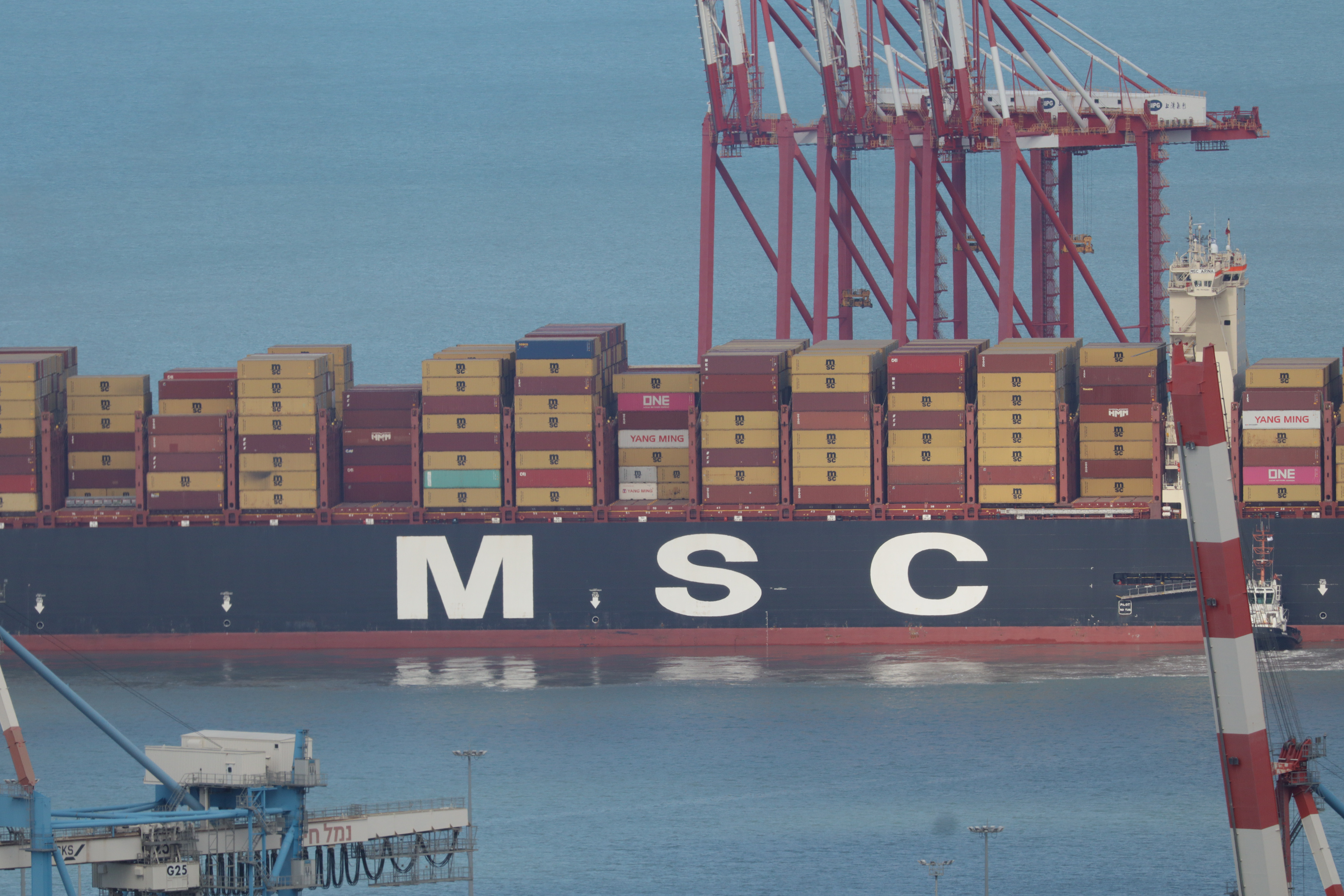
Look a little longer and the scale of the system becomes clearer. Each container stacked across the vessel’s deck represents thousands of products moving between continents—electronics, machinery, clothing, chemicals, construction materials, the mundane but essential cargo that keeps global economies functioning. The ship itself is a moving warehouse, and ports like the one in the photograph operate as gigantic choreography machines where cranes, trucks, and vessels move in constant synchronization. Under normal conditions the scene is almost boring in its efficiency.
That routine is precisely what becomes fragile when geopolitical risk spills into maritime space.
MSC’s decision to halt exports from the Gulf is not just about avoiding a dangerous voyage. It reflects a cascading set of operational constraints that begin the moment conflict threatens a shipping corridor. War-risk insurers may withdraw coverage or raise premiums to levels that make voyages economically impossible. Naval activity and missile threats can turn narrow sea lanes into unpredictable environments. Crews, already working in demanding conditions, suddenly face the possibility that a commercial voyage could become a military incident.
Shipping companies are among the most pragmatic actors in the global economy. Their decisions tend to be guided less by political statements and more by operational calculus. When a carrier like MSC suspends bookings or adjusts voyages, it means the risk equation has shifted sharply enough to disrupt the delicate balance of global logistics.
The Strait of Hormuz sits at the center of that equation. The waterway is narrow, heavily trafficked, and strategically unavoidable for many exporters in the Persian Gulf. Roughly a fifth of the world’s oil passes through it, along with large volumes of petrochemicals, industrial materials, and containerized goods. A disruption there is not localized; it radiates outward through energy markets, shipping networks, and supply chains that stretch across continents.
In practical terms, halting exports creates immediate ripple effects. Containers scheduled for Gulf destinations may be diverted to other ports or held at transshipment hubs. Importers waiting for goods face delays that can ripple through manufacturing lines and retail supply chains. Freight planners must improvise routes and schedules while watching insurance costs and security updates hour by hour.
The photograph of the MSC vessel suddenly feels different in that context. What appears to be a stable, mechanical landscape is actually part of an incredibly sensitive global system. The towering cranes, the perfectly stacked containers, the massive hull resting calmly in the harbor—all of it depends on the assumption that the sea lanes connecting ports remain open and predictable.
When a chokepoint like the Strait of Hormuz becomes uncertain, the machinery of global trade slows. Ships wait. Routes change. Cargo accumulates in unexpected places. And a scene that normally represents the quiet confidence of international commerce begins to look like something more fragile—an enormous logistical structure balanced on the stability of a few narrow waterways.
MSC’s halt of Gulf exports is therefore more than a tactical adjustment. It is a reminder that global trade still moves through physical corridors, and when those corridors become unstable, the entire system must pause and rethink its course.