Why Tanker Jetties Fire Their Water Cannons: Inside the Safety Systems Protecting Liquid Cargo Berths
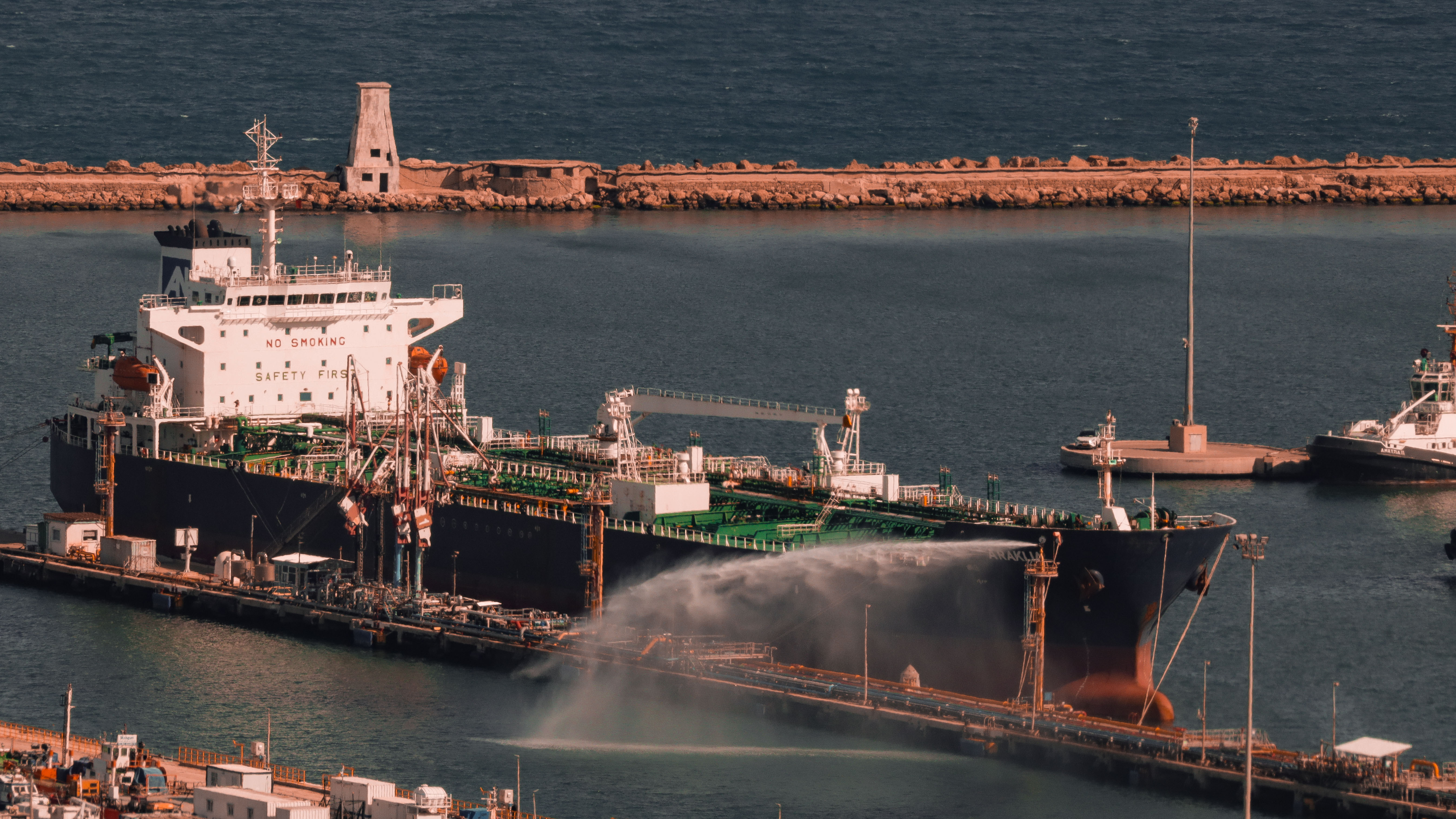
A tanker sits firmly alongside a liquid cargo jetty, tugs nearby in the basin, and a powerful arc of water sweeps across the ship’s bow. At first glance it almost looks theatrical, like a ceremonial water salute. In reality, what you are seeing is one of the most serious systems in tanker terminal operations being exercised: the fixed firefighting monitors that protect liquid cargo berths.
Tanker jetties are among the highest-risk operational environments in commercial ports. Unlike container terminals or bulk cargo quays, these berths handle flammable liquids under pressure, often transferred through loading arms directly into a vessel’s cargo manifold. A minor failure—leakage from a flange, a ruptured hose, static discharge during transfer—can escalate rapidly if vapors ignite. Because of that, tanker terminals are designed around the assumption that a fire could occur and must be suppressed immediately. The towering water monitors mounted along the jetty form the first line of defense.
These monitors are not small fire hoses. They are industrial firefighting cannons capable of throwing enormous volumes of seawater across the length of a tanker deck. Depending on the terminal design, a single monitor may discharge several thousand liters of water per minute, and a modern jetty will often have multiple units positioned to overlap their coverage zones. When activated, they can create a water curtain over the vessel’s cargo manifold area, cool heated steel surfaces, dilute flammable vapor clouds, and protect critical equipment during an emergency.
The water arc visible in scenes like this is often the result of a readiness test. Ports handling oil products, chemicals, or liquefied gases conduct regular drills to ensure that their emergency systems function exactly as intended. Pumps must start instantly, valves must open without hesitation, and monitors must rotate and project water far enough to cover the entire working deck of a tanker. These tests are not optional exercises; they are a core element of international tanker terminal safety standards.
The safety philosophy behind these systems is layered. Fixed monitors on the jetty form the stationary backbone of firefighting capability, but they are rarely the only line of response. Tugboats assisting tankers into berth frequently carry their own firefighting equipment, allowing them to project water or foam toward the vessel from the water side. Shore-based fire crews and terminal emergency teams stand ready to respond as well. Together, these assets form an integrated response network designed to contain incidents within minutes rather than hours.
Another critical role of the water monitors is thermal protection. If a fire were to break out near cargo manifolds or deck pipelines, the intense heat could threaten the integrity of the ship’s structure and cargo containment systems. By continuously bathing surfaces in water, the monitors help cool the steel and prevent escalation. In many scenarios, the goal is not necessarily to extinguish a fire immediately but to prevent it from spreading while emergency shutdown procedures isolate the cargo system.
The presence of such heavy firefighting infrastructure is a reminder of how specialized tanker terminals have become. These berths are deliberately separated from the main cargo port, often extending far into the harbor on narrow jetties. Pipelines run along elevated racks, connecting ships directly to storage tanks or refineries onshore. Emergency shutdown valves, breakaway couplings, gas detection sensors, and spill containment systems are all part of the design. The water monitors are simply the most visible expression of a much broader safety architecture.
For maritime professionals, the sight of a tanker under a sweeping water arc signals something reassuring rather than alarming. It means the terminal is testing its reflexes. Fire pumps are being exercised, monitor bearings are turning freely, and the response systems that protect both vessel and port are being proven operational.
Moments like this can pass almost unnoticed by casual observers along the waterfront. But for those who work in shipping and port operations, the dramatic arc of water tells a deeper story: a port rehearsing its readiness for the rare but serious events that tanker terminals must always be prepared to face.