Why Small Container Ships Still Make Sense in a Mega-Ship World
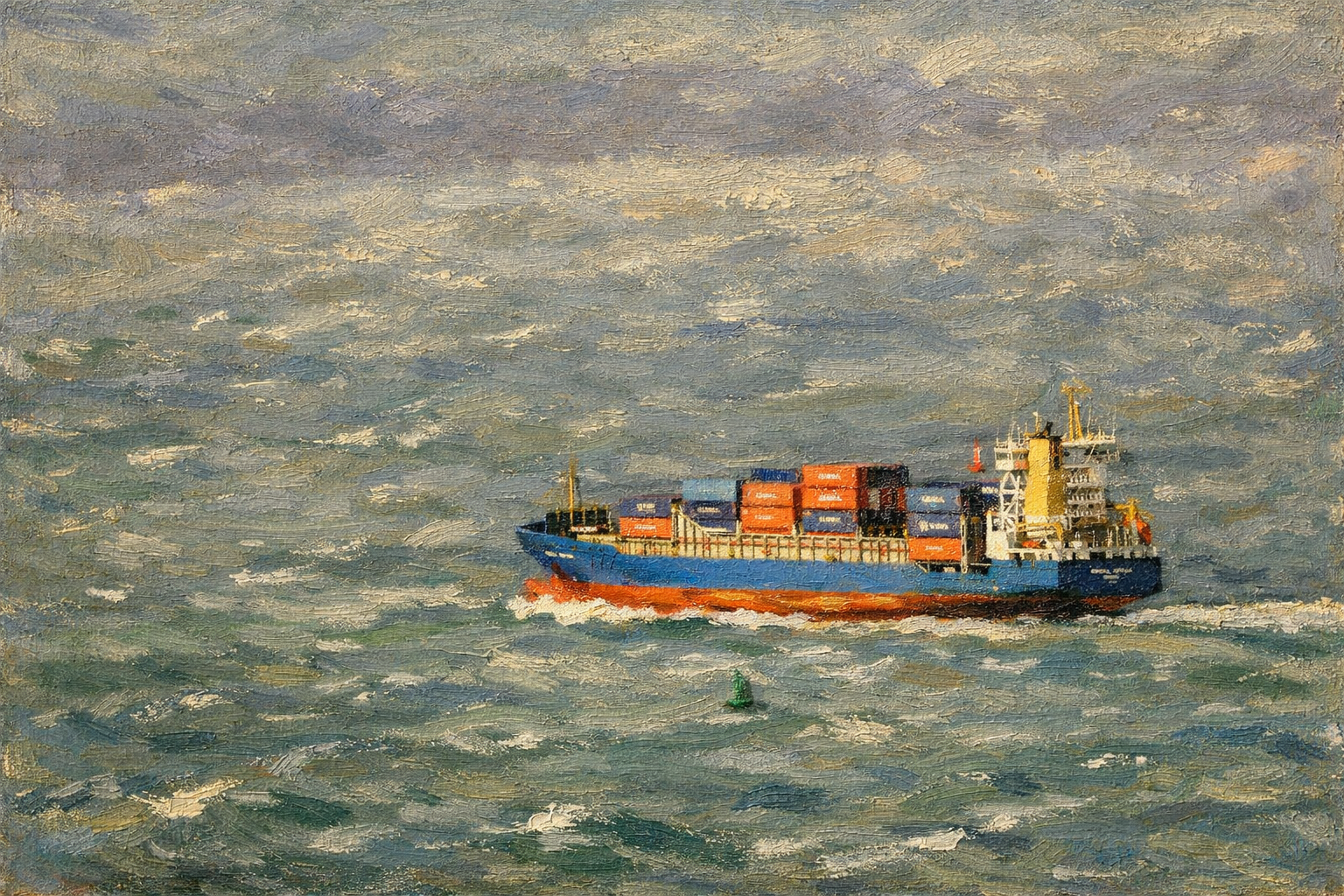
The image sets the tone immediately: a compact container vessel cutting across a restless grey sea, its hull painted a working blue with a rust-orange waterline, stacks of multicolored containers rising just a few tiers high rather than towering like floating skyscrapers. The ocean around it looks unsettled, flecked with whitecaps, and the ship feels exposed in a way ultra-large vessels never quite do, more human-scaled, more vulnerable, but also more agile. There’s a sense of purpose here, not spectacle. This is not a ship built to dominate trade routes between continents, but one designed to move steadily, repeatedly, and efficiently through narrower lanes of global commerce.
Operating small container ships is, at its core, a business model built around flexibility rather than brute efficiency. Mega-ships win on cost per container when everything goes right: full loads, deepwater ports, synchronized schedules, massive cranes waiting on arrival. Small ships operate in a different economic reality. They serve secondary ports, regional hubs, island economies, and routes where demand is steady but never explosive. In these contexts, a smaller vessel isn’t a compromise, it’s the correct tool. Port fees are lower, berth availability is higher, turnaround times are shorter, and the ship doesn’t sit idle waiting to fill thousands of slots before departure. That rhythm matters more than raw scale, especially when margins are thin and reliability is a selling point.
Another often overlooked advantage is risk distribution. A single ultra-large container ship represents an enormous concentration of capital, cargo value, and operational risk. When something goes wrong, weather, labor disputes, mechanical issues, canal blockages, the financial shockwaves are immediate and severe. Small ships spread that risk. They can be rerouted more easily, substituted faster, and absorbed into alternative schedules without collapsing an entire network. From a business perspective, this resilience has real monetary value, even if it doesn’t show up neatly in a per-TEU cost calculation. It’s a kind of insurance policy built into the fleet design, one that looks especially smart in an era of geopolitical friction and climate-driven disruptions.
Fuel economics also play a quieter but decisive role. Smaller ships consume less fuel overall and offer more flexibility in speed management. Slow steaming, route optimization, and partial loads hurt mega-ships disproportionately, while smaller vessels remain viable across a wider range of operating conditions. As emissions regulations tighten and fuel prices remain volatile, this adaptability becomes a strategic asset. Retrofitting or transitioning smaller ships to alternative fuels or hybrid systems is also, bluntly, more achievable than doing the same at extreme scale. The math is simpler, the capex lower, the experimentation safer. No one wants their first big alternative-fuel mistake to happen on a floating city.
Then there’s the network logic. Global shipping increasingly resembles a mesh rather than a straight line. Mega-ships dominate trunk routes between major hubs, but everything beyond that depends on feeders. Small container ships are the connective tissue, the part that actually brings goods to where people live and businesses operate. Without them, the efficiency of the biggest vessels collapses into bottlenecks. From a business standpoint, owning or chartering smaller ships isn’t just about serving niche markets; it’s about controlling access to the last mile of maritime logistics. That control translates into negotiating power, customer loyalty, and the ability to offer end-to-end solutions rather than isolated ocean crossings.
Looking again at the ship in the image, moving steadily across open water with no drama, no excess, just containers and purpose, it becomes clear why this segment refuses to disappear. Small container ships aren’t relics of a pre-mega-ship era. They’re precision instruments in a system that has grown too complex to be served by giants alone. Their business rationale isn’t rooted in nostalgia or necessity, but in a pragmatic understanding of how trade actually flows: unevenly, regionally, and under constant uncertainty. Sometimes, smaller really is smarter, even out there on a rough, grey sea.