Short Loops, Quiet Power: What Ital Way Says About the New Container Playbook
The ship in the image feels deliberately unflashy, and that’s part of what makes it interesting. Ital Way sits heavy in the water, stacked but not towering, its Evergreen containers arranged in disciplined blocks that look substantial without tipping into excess. The hull’s green cuts cleanly through a slightly fogged seascape, the horizon softened, almost undecided. A few small sailboats drift in the distance, which makes the scale difference obvious but not theatrical. This is not a mega-ship flexing dominance; it’s a working vessel doing a specific job, moving steadily, efficiently, and without spectacle. The calm wake behind it feels like a clue rather than a detail.
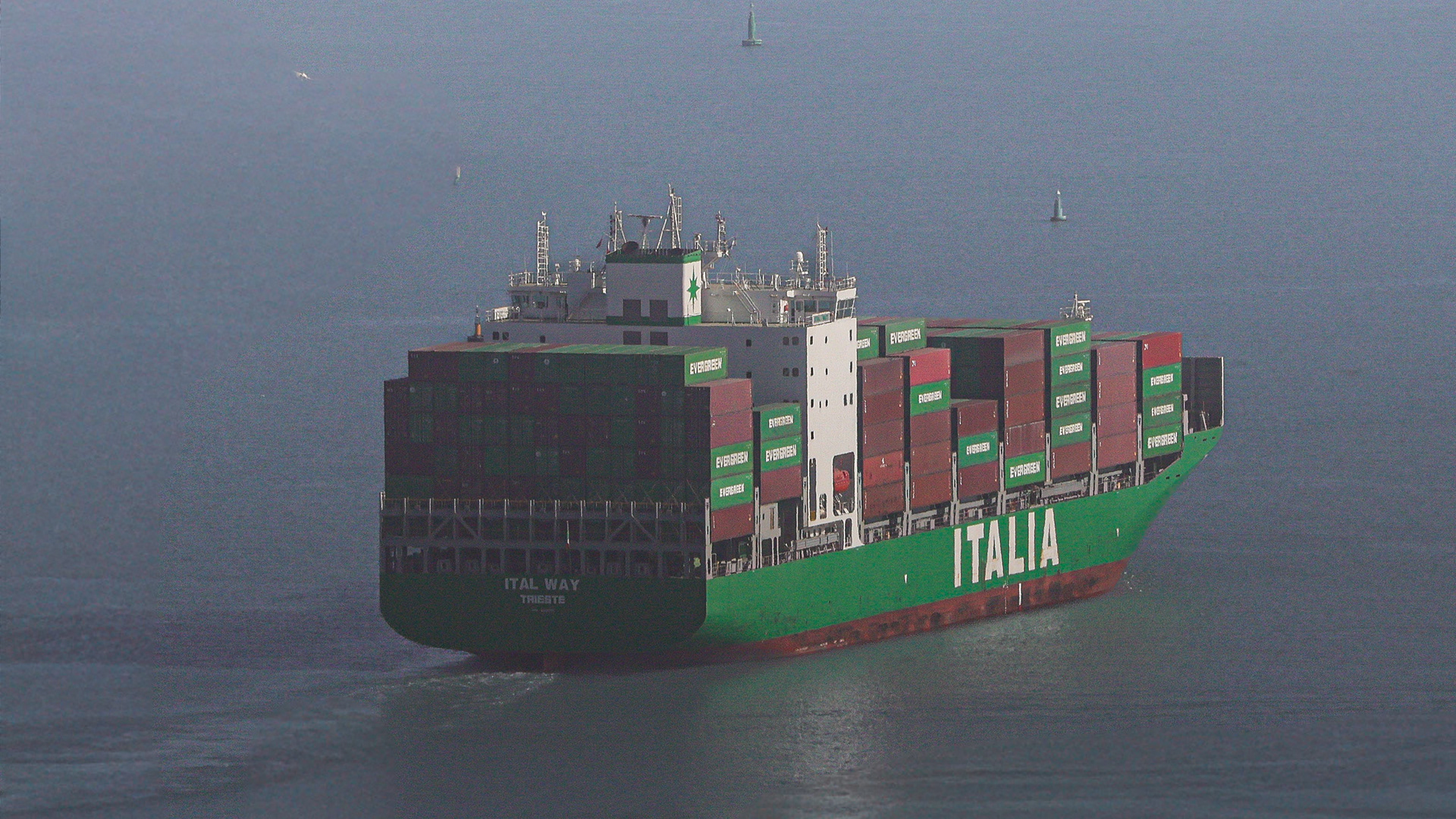
Seen in context, Ital Way reflects a broader and very current pattern in container shipping: the renewed value of smaller, more flexible ships operating on shorter regional routes. Over the past decade, the industry obsessed over scale, pushing ever larger vessels onto long-haul Asia–Europe and transpacific lanes. That logic made sense when demand was booming and ports were racing to expand. What has changed is not just volumes but uncertainty. Congestion, security risks, shifting trade flows, and uneven demand have made rigid, mega-ship schedules less attractive. Ships like Ital Way, operating within the Mediterranean on relatively short loops, offer carriers something that has become strategically precious again: optionality.
Flexibility here isn’t a buzzword, it’s operational. A mid-sized container ship can be redeployed quickly, skip or add port calls without breaking an entire network, and serve as a buffer when larger vessels are delayed or rerouted. On Mediterranean and Eastern Med routes, where ports are closer together and cargo flows can be lumpy rather than constant, this kind of ship is ideal. Ital Way can connect Italy, Greece, Israel, and nearby hubs in days, not weeks, smoothing container availability without committing excess capacity. If demand dips, it’s easier to slow steam or reshuffle; if demand spikes locally, the ship can absorb it without the distortion a mega-vessel would introduce.
There’s also a risk-management angle hiding in plain sight. Shorter routes mean less exposure to chokepoints and geopolitical flashpoints that have become increasingly disruptive to long-haul shipping. While global headlines focus on canal transits and ocean-scale diversions, a ship like Ital Way earns its keep by keeping regional trade moving regardless of what happens farther afield. For ports in the Eastern Mediterranean, this reinforces their role not just as endpoints, but as flexible nodes in a web of short connections. The image, with its muted light and untroubled sea, quietly captures that reality: resilience doesn’t always look dramatic.
What’s striking is how normal all of this appears. Nothing about the ship screams transition or strategy at first glance, and that’s exactly why it matters. The container market’s shift toward smaller vessels on shorter routes isn’t a headline-grabbing revolution; it’s a pragmatic adjustment happening ship by ship, loop by loop. Ital Way is a physical expression of that adjustment, a reminder that in a world where predictability is fragile, the ability to move modest volumes reliably and adapt quickly has become just as valuable as raw scale. The fog in the background doesn’t stop the ship. It simply narrows the view, and the ship keeps going anyway.